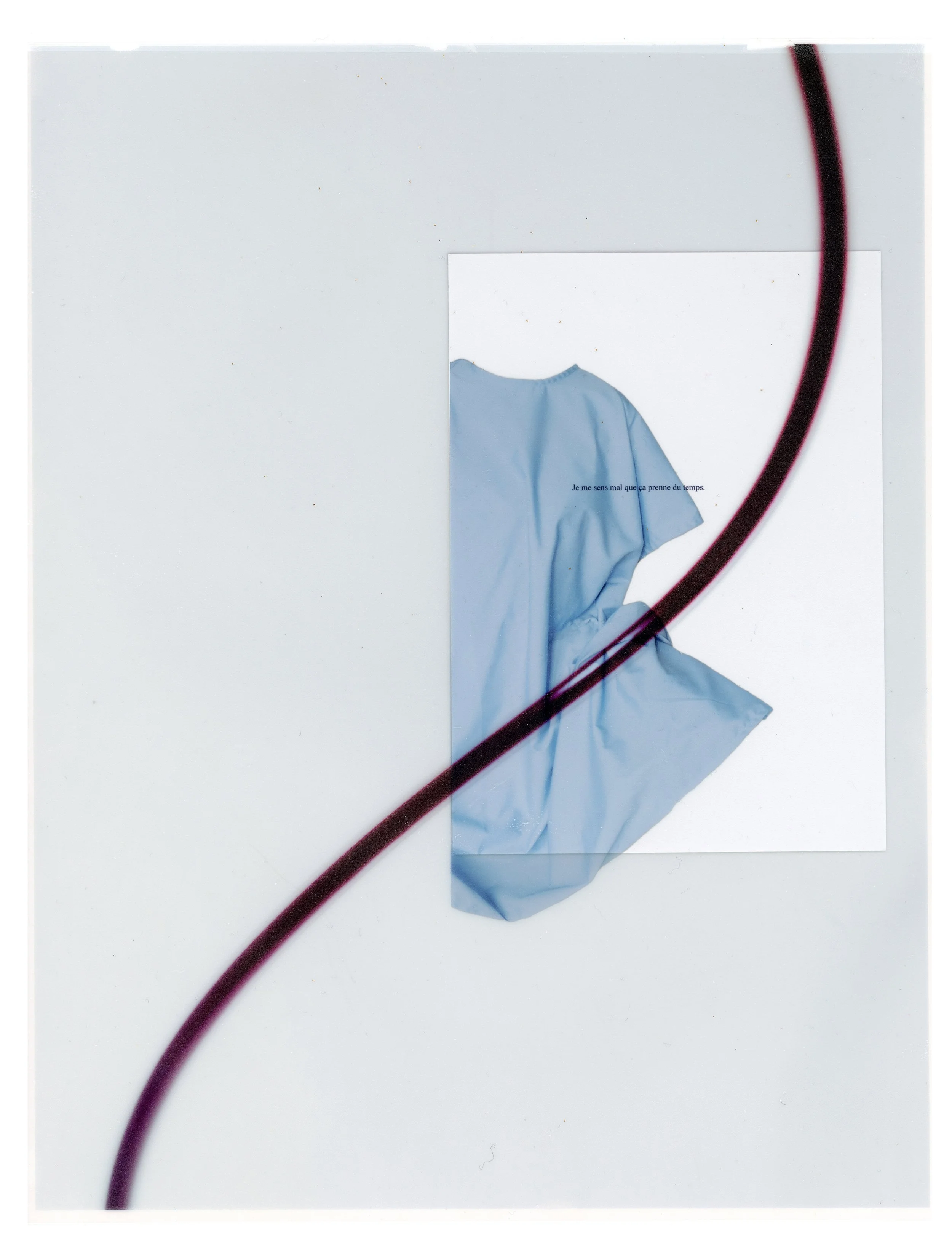
Sur la plus longue table de son atelier, Annie France Noël étale des œuvres qui témoignent de plusieurs moments de sa pratique, de sa relation intime au détail, mais aussi de son expérience postpartum. Elle cherche à réorganiser ses archives personnelles, tangibles et intangibles, et à créer des images pour faire sens du traumatisme vécu et lui donner la forme d’un livre d’artiste. Dans le processus, elle retrouve du pouvoir et de l’agentivité, au-delà de la position parfois déshumanisante de patiente. Elle crée une conversation, à postériori, avec le corps médical, dans un geste de réappropriation de l’information, mais surtout de son expérience vécue. Son travail déploie une réflexion délicate qui parle de la censure et de l’aseptisation de l’expérience du corps. Sur une des images, le rouge du papier vélum colore une note d’admission à l’hôpital. Sur une autre image, une prescription de médicament est superposée à un autoportrait de l’artiste où elle cadre ses mains déposées sur son ventre et sa peau nue. Un troisième élément s’inspire de l’aiguille et du fil de suture pour indiquer une plaie, une blessure. À travers celles-ci, elle aborde l’impact de certains gestes posés par le corps médical, dont la compréhension n’est pas accessible pour les personnes patientes. Elle relève ces occurrences où elle a subi, sans pouvoir consentir. Annie France explore l’image, mais aussi le texte, puisque l’artiste s’offre le recul nécessaire pour expliquer avec nuance la complexité des ressentis liés à cette expérience chargée qui se passe dans l’urgence. Lui reste maintenant à relier ces fragments et laisser les silences être porteurs de sens à leur tour.
Poète / Artiste visuelle
Directrice générale du Projet Borgitte
(Avril 2026)
Éloïse LeBlanc

Photo: Jacques Cormier
Annie France Noël created a performance of gentle actions which was visually stunning, thematically ritualistic, and slightly unsettling. Dressed in a floor-length, deep royal blue dress, Noël sat in an old-style carved wood chair facing the audience. At her feet was a burlap bag of unprocessed wool. She slowly pulled blue woollen threads from a fold of her dress, all below the waist, one after the other, as if her veins, her tissue, her insides were being exposed. Threads in various blues tangled together. Simultaneously, the use of woollen thread inspired memories of women knitting, crocheting together, and teaching the younger family members skills. It was also evocative of family togetherness […], of creating blankets/clothing, birthing a child, or pulling out memories all wound up together in the never-ending cycle of life—the inheritances of culture and social behaviour we are all given. She sang a work song, a lullaby as she worked. Her calm and gentle movements revealed care...
This was Noël’s first foray into public performance art. The blue of her dress and the woollen threads refer to “the baby blues,” she says—a description of the post-birth experience of hormonal imbalance leading to sadness, depression and other mental issues. Blue is the colour of calm and also sorrow, Noël says, referencing the hospital gown, the medical pads, the glow of the baby monitor. At the end of the performance, there was a large tangle of knotted threads, impossible to unravel, which she held up to regard. The many post-birth experiences of learning to care for herself and her little one? Her patience and focus throughout this performance leave us to believe that caring is primary for her, despite any struggles.
Interdisciplinary Artist
(Spring 2025)
Linda Rae Dornan